Venkat Subramaniam

Founder @ Agile Developer, Inc.
Dr. Venkat Subramaniam is an award-winning author, founder of Agile Developer, Inc., creator of agilelearner.com, and an instructional professor at the University of Houston.He has trained and mentored thousands of software developers in the US, Canada, Europe, and Asia, and is a regularly-invited speaker at several international conferences. Venkat helps his clients effectively apply and succeed with sustainable agile practices on their software projects.
Venkat is a (co)author of multiple technical books, including the 2007 Jolt Productivity award winning book Practices of an Agile Developer. You can find a list of his books at agiledeveloper.com. You can reach him by email at venkats@agiledeveloper.com or on twitter at @venkat_s.
Presentations
Functional Programming Workshop
9:00 AM MDT
With Java supporting lambda expressions, we have nothing to stop us from creating functional style of code for our day to day applications. We're so used to object-oriented programming, but remember the paradigm shift we went through to adapt to that way of programming. It is yet another paradigm shift and most of us wonder how in the world can we write functional style code. Much like how OO was not as much about the syntax as it was about the design, functional programming is about the design, the idioms, and the data structures we'd use to program.
In this hands-on workshop, we will learn about functional programming using practical examples, create small apps that will make use of this style of programming, and relate to how it differs from the traditional way we're used to and the benefits it offers.
Java 8 Language Capabilities - What's in it for you?
8:30 AM MDT
There is a good amount of excitement about the new version of Java. The big
evolution of course is the lambda expressions. In this presentation we will dive into the language features in Java 8, take a look at some of their nuances, and look at ways to put them to good use.
Java 8 language capabilities and application.
Demystifying invokedynamic
10:30 AM MDT
Invoke dynamic is a Java 7 feature that had the most impact at the bytecode level and also in terms of performance. First perceived as a feature to help dynamically typed languages on the JVM, it turned into a powerful feature that has been exploited quite a bit in the implementation of features in the Java
language itself.
In this presentation we will understand what problem this features really solves and how it has influenced other features in the Java language and on the Java platform.
Concurrency without Pain in Pure Java
1:30 PM MDT
Programming concurrency has turned into a herculean task. I call the traditional approach as the synchronized and suffer model. Fortunately, there are other approaches to concurrency and you can reach out to those directly from your Java code.
In this presentation we will discuss the actor based concurrency and also the software transaction memory. We will then develop examples using AKKA and compare the power of these approaches in contrast to the traditional approach.
Understanding the "NO" in NoSQL
3:15 PM MDT
Relational databases have ruled the world since the dawn of time (or so it appears). They power our enterprises and for many in the corporate world, it may be hard to imagine life without them. Each decade a novel idea would challenge the status quo and make a case to deviate for the tradition. A flock of enthusiastic programmers, like your humble speaker back in the early 90s, would throw their support around it, only to be crushed eventually by the large vendors and enterprise standards. But, the excitement around NoSQL has shown that enterprise data is not the only thing that's persistent.
In this presentation we'll learn how NoSQL deviates from those deep rooted traditional approaches, and how this may be useful. We will also discuss the situations where these types of databases may be more appropriate.
A dozen cool things we can do with popular JVM Languages
5:00 PM MDT
Languages offer a lot more than syntax and compilers. They often have supporting libraries and special facilities that set them apart from other languages. Some languages offer special compiler support for a particular construct, like tail call optimization, for example. Others provide interesting library support or capabilities.
In this presentation we will dive into 12 cool things we can do with different languages on the JVM, things that are either impossible or hard to do in Java, but are quite easy and useful to realize in other popular languages on the JVM. If mixing these languages is an option on your projects, you'll have dozen more reasons after this presentation.
The Art of Simplicity
7:15 PM MDT
We've been told to keep things simple. It turns out, that's easily said than done. Creating something simple is, well, not really that simple. If simple was sitting next to us, would we even recognize it? Is my design simple, is yours simple? How can we tell?
That's a simple question, but the answer to it is… well come to this talk to find out.
Programming with HTML 5
1:30 PM MDT
Developing a rich user interface for web applications is both exciting and challenging. HTML 5 has closed the gaps and once again brought new vibe into programming the web tier. Come to this session to learn how you can make use of HTML 5 to create stellar applications.
.
HTML 5 Animations - building true richness on the web
3:15 PM MDT
User experience and rich interaction is top in the list of things that influence the success and adoption of applications. Such richness and interactions were owned by desktop and native applications in the past. Over the recent years the web has become increasingly interactive, but the true richness was still lacking. But all that has changed with HTML 5 canvas and animation techniques.
Come to this session to learn how to create rich interactive applications with good animation, mouse and touch based interactions.
Developing Offline Applications with HTML 5
5:00 PM MDT
Mobile devices are gaining popularity but the diversity of these devices poses a challenge for development. HTML 5 promises to bring a consistent API to program the client side for both desktop and diverse mobile devices. One additional challenge with mobile devices is network connectivity, or the lack of it. Mobile devices are often taken into remote areas with low or no connectivity. While a native app can run on the device anytime, a web based application by default depends on having connectivity, unless of course we use the offline capabilities of HTML 5. Come to this presentation to learn how to create applications that can switch seamlessly between connected and offline mode.
Learn about offline options, configurations, local storage and how to program all of that, in this highly interactive, live coding session.
Applying Groovy Metaprogramming (Workshop)
9:00 AM MDT
Multiple languages on the JVM offer the ability to write concise and expressive code. One thing that sets Groovy apart, more distinctively than a few others, is its ability to extend the program at runtime.
Classes are open in Groovy and we can not only add methods, but we can synthesize methods as well, at runtime. This ability provides for quite an interesting set of flexibilities, paving the way to create highly dynamic applications, domain specific languages, lightweight configurable components, all with less code.
In this workshop we will dive into metaprogramming in Groovy, using practical hands-on examples and make use of it to create some dynamic behavior. We will focus on concepts and techniques you can readily put to real use on your next project.
Applying Groovy Metaprogramming (Workshop)
10:45 AM MDT
Multiple languages on the JVM offer the ability to write concise and expressive code. One thing that sets Groovy apart, more distinctively than a few others, is its ability to extend the program at runtime.
Classes are open in Groovy and we can not only add methods, but we can synthesize methods as well, at runtime. This ability provides for quite an interesting set of flexibilities, paving the way to create highly dynamic applications, domain specific languages, lightweight configurable components, all with less code.
In this workshop we will dive into metaprogramming in Groovy, using practical hands-on examples and make use of it to create some dynamic behavior. We will focus on concepts and techniques you can readily put to real use on your next project.
Design Patterns in Groovy
1:30 PM MDT
When I got into Java I had a “Wow, look how easy it is to implement these patterns.” When I got into Groovy, I had the same reaction, but only better. The dynamic nature of Groovy makes it easier to implement some common patterns. What's better, there are some patterns that you can exploit in Groovy that are not so easy in Java. In this section, you will learn how to implement some traditional patters in Groovy, and also other patterns you are simply not used to in Java.
This presentation will go far beyond the Gang-of-four (GOF) patterns. You will learn how to implement some GOF patterns, but also some patterns that will allow you to exploit dynamic nature of Groovy and the elegance of Groovy closures.
Books

Test-Driving JavaScript Applications: Rapid, Confident, Maintainable Code
by Venkat Subramaniam
Debunk the myth that JavaScript is not easily testable. Whether you use Node.js, Express, MongoDB, jQuery, AngularJS, or directly manipulate the DOM, you can test-drive JavaScript. Learn the craft of writing meaningful, deterministic automated tests with Karma, Mocha, and Chai. Test asynchronous JavaScript, decouple and properly mock out dependencies, measure code coverage, and create lightweight modular designs of both server-side and client-side code. Your investment in writing tests will pay high dividends as you create code that's predictable and cost-effective to change.
Design and code JavaScript applications with automated tests. Writing meaningful tests is a skill that takes learning, some unlearning, and a lot of practice, and with this book, you'll hone that skill. Fire up the editor and get hands-on through practical exercises for effective automated testing and designing maintainable, modular code.
Start by learning when and why to do manual testing vs. automated verification. Focus tests on the important things, like the pre-conditions, the invariants, complex logic, and gnarly edge cases. Then begin to design asynchronous functions using automated tests. Carefully decouple and mock out intricate dependencies such as the DOM, geolocation API, file and database access, and Ajax calls to remote servers.
Step by step, test code that uses Node.js, Express, MongoDB, jQuery, and AngularJS. Know when and how to use tools such as Chai, Istanbul, Karma, Mocha, Protractor, and Sinon. Create tests with minimum effort and run them fast without having to spin up web servers or manually edit HTML pages to run in browsers. Then explore end-to-end testing to ensure all parts are wired and working well together.
Don't just imagine creating testable code, write it.
What You Need:
A computer with a text editor and your favorite browser. The book provides instructions to install the necessary automated testing-related tools.
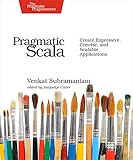
Pragmatic Scala: Create Expressive, Concise, and Scalable Applications
by Venkat Subramaniam
Our industry is moving toward functional programming, but your object-oriented experience is still valuable. Scala combines the power of OO and functional programming, and Pragmatic Scala shows you how to work effectively with both. Updated to Scala 2.11, with in-depth coverage of new features such as Akka actors, parallel collections, and tail call optimization, this book will show you how to create stellar applications.
This thorough introduction to Scala will get you coding in this powerful language right away. You'll start from the familiar ground of Java and, with easy-to-follow examples, you'll learn how to create highly concise and expressive applications with Scala. You'll find out when and how to mix both imperative and functional style, and how to use parallel collections and Akka actors to create high-performance concurrent applications that effectively use multicore processors.
Scala has evolved since the first edition of this book, and Pragmatic Scala is a significant update. We've revised each chapter, and added three new chapters and six new sections to explore the new features in Scala. You'll learn how to:
Safely manage concurrency with parallel collections and Akka actors
Create expressive readable code with value classes and improved implicit conversions
Create strings from data with no sweat using string interpolation
Create domain-specific languages
* Optimize your recursions with tail call optimization
Whether you're interested in creating concise, robust single-threaded applications or highly expressive, thread-safe concurrent programs, this book has you covered.
What You Need:
The Scala compiler (2.x) and the JDK are required to make use of the concepts and the examples in this book.
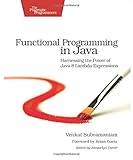
Functional Programming in Java: Harnessing the Power Of Java 8 Lambda Expressions
by Venkat Subramaniam
Intermediate level, for programmers fairly familiar with Java, but new to the functional style of programming and lambda expressions.
Get ready to program in a whole new way. Functional Programming in Java will help you quickly get on top of the new, essential Java 8 language features and the functional style that will change and improve your code. This short, targeted book will help you make the paradigm shift from the old imperative way to a less error-prone, more elegant, and concise coding style that's also a breeze to parallelize. You'll explore the syntax and semantics of lambda expressions, method and constructor references, and functional interfaces. You'll design and write applications better using the new standards in Java 8 and the JDK.
Lambda expressions are lightweight, highly concise anonymous methods backed by functional interfaces in Java 8. You can use them to leap forward into a whole new world of programming in Java. With functional programming capabilities, which have been around for decades in other languages, you can now write elegant, concise, less error-prone code using standard Java. This book will guide you though the paradigm change, offer the essential details about the new features, and show you how to transition from your old way of coding to an improved style.
In this book you'll see popular design patterns, such as decorator, builder, and strategy, come to life to solve common design problems, but with little ceremony and effort. With these new capabilities in hand, Functional Programming in Java will help you pick up techniques to implement designs that were beyond easy reach in earlier versions of Java. You'll see how you can reap the benefits of tail call optimization, memoization, and effortless parallelization techniques.
Java 8 will change the way you write applications. If you're eager to take advantage of the new features in the language, this is the book for you.
What you need:
Java 8 with support for lambda expressions and the JDK is required to make use of the concepts and the examples in this book.
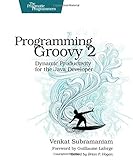
Programming Groovy 2: Dynamic Productivity for the Java Developer (Pragmatic Programmers)
by Venkat Subramaniam
Groovy brings you the best of both worlds: a flexible, highly productive, agile, dynamic language that runs on the rich framework of the Java Platform. Groovy preserves the Java semantics and extends the JDK to give you true dynamic language capabilities. Programming Groovy 2 will help you, the experienced Java developer, learn and take advantage of the latest version of this rich dynamic language. You'll go from the basics of Groovy to the latest advances in the language, including options for type checking, tail-call and memoization optimizations, compile time metaprogramming, and fluent interfaces to create DSLs.
You don't have to leave the rich Java Platform to take advantage of Groovy. Groovy preserves Java's semantics and extends the JDK, so programming in Groovy feels like the Java language has been augmented; it's like working with a lighter, more elegant Java. If you're an experienced Java developer who wants to learn how Groovy works, you'll find exactly what you need in this book.
You'll start with the fundamentals of programming in Groovy and how it works with Java, and then you'll explore advanced concepts such as unit testing with mock objects, using Builders, working with databases and XML, and creating DSLs. You'll master Groovy's powerful yet complex run-time and compile-time metaprogramming features.
Much has evolved in the Groovy language since the publication of the first edition of Programming Groovy. Programming Groovy 2 will help you learn and apply Groovy's new features. Creating DSLs is easier now, and Groovy's already-powerful metaprogramming facilities have improved even more. You'll see how to work with closures, including tail call optimization and memoization. The book also covers Groovy's new static compilation feature.
Whether you're learning the basics of the language or interested in getting proficient with the new features, Programming Groovy 2 has you covered.
What You Need
To work on the examples in the book you need Groovy 2.0.5 and Java JDK 5 or higher.
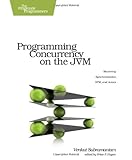
Programming Concurrency on the JVM: Mastering Synchronization, STM, and Actors
by Venkat Subramaniam
More than ever, learning to program concurrency is critical to creating faster, responsive applications. Speedy and affordable multicore hardware is driving the demand for high-performing applications, and you can leverage the Java platform to bring these applications to life.
Concurrency on the Java platform has evolved, from the synchronization model of JDK to software transactional memory (STM) and actor-based concurrency. This book is the first to show you all these concurrency styles so you can compare and choose what works best for your applications. You'll learn the benefits of each of these models, when and how to use them, and what their limitations are.
Through hands-on exercises, you'll learn how to avoid shared mutable state and how to write good, elegant, explicit synchronization-free programs so you can create easy and safe concurrent applications. The techniques you learn in this book will take you from dreading concurrency to mastering and enjoying it. Best of all, you can work with Java or a JVM language of your choice - Clojure, JRuby, Groovy, or Scala - to reap the growing power of multicore hardware.
If you are a Java programmer, you'd need JDK 1.5 or later and the Akka 1.0 library. In addition, if you program in Scala, Clojure, Groovy or JRuby you'd need the latest version of your preferred language. Groovy programmers will also need GPars.

Practices of an Agile Developer: Working in the Real World (Pragmatic Bookshelf)
by Venkat Subramaniam and Andy Hunt
These are the proven, effective agile practices that will make you a better developer. You'll learn pragmatic ways of approaching the development process and your personal coding techniques. You'll learn about your own attitudes, issues with working on a team, and how to best manage your learning, all in an iterative, incremental, agile style. You'll see how to apply each practice, and what benefits you can expect. Bottom line: This book will make you a better developer.
.NET Gotchas
by Venkat Subramaniam
Like most complex tasks, .NET programming is fraught with potential costly, and time-consuming hazards. The millions of Microsoft developers worldwide who create applications for the .NET platform can attest to that. Thankfully there's now a book that shows you how to avoid such costly and time-consuming mistakes. It's called .NET Gotchas.The ultimate guide for efficient, pain-free coding, .NET Gotchas from O'Reilly contains 75 common .NET programming pitfalls--and advice on how to work around them. It will help you steer away from those mistakes that cause application performance problems, or so taint code that it just doesn't work right.The book is organized into nine chapters, each focusing on those features and constructs of the .NET platform that consistently baffle developers. Within each chapter are several "gotchas," with detailed examples, discussions, and guidelines for avoiding them. No doubt about it, when applied, these concise presentations of best practices will help you lead a more productive, stress-free existence.What's more, because code examples are written in both VB.NET and C#, .NET Gotchas is of interest to more than 75 percent of the growing numbers of .NET programmers. So if you're a .NET developer who's mired in the trenches and yearning for a better way, this book is most definitely for you.